
Grant County Court Records After Arrest
After a person is arrested in Grant County and booked at the Grant County Jail, the custody record and the court record split into different tracks. The jail or sheriff can confirm custody, holds, and release status. The court record begins when a case is filed with Grant County District Court or when an existing warrant, citation, or criminal case is updated after the arrest.
The Grant County Attorney, Kelly Premer Chavez, is the local prosecutor for crimes referred by law enforcement. That office may file the same charges listed at booking, amend them, reduce them, add charges, or decline charges after review. For custody and booking detail, use jail inmate records. For booking photos and mugshot-request limits, use jail mugshots. Filed charges, hearing dates, warrants in a court case, dispositions, and later orders belong with the District Court record.
Find Grant County Court Records
Grant County District Court is the trial court for criminal cases in the county. It is part of the 26th Judicial District and has general original jurisdiction over civil and criminal matters. Clerk Reid Borchetta's office is at 108 S. Glenn, Second Level, Ulysses, KS 67880, phone 620-356-1526, with published hours Monday through Friday, 8 a.m. to 5 p.m. The judges listed are Mike Winner, Clint B. Peterson, Bradley E. Ambrosier, and Linda P. Gilmore.
The Kansas Judicial Branch provides statewide court search at Kansas Case Search. Use it for case-level information after a Grant County arrest when a defendant name, citation, or case number is known. If no record appears, call the clerk because older, restricted, juvenile, sealed, or expunged records may not display.
- Open Kansas Case Search and choose a search method that matches the information available.
- Search by defendant legal name first, then try case number, business name, or citation if those are available from paperwork.
- Open the matching case and review filed charges, hearings, warrants, bond orders, and dispositions.
- Compare the court charge list with the jail booking basis, because booking charges can differ from the final filed case.
Kansas District Court Records explains courthouse and online access, subject to restrictions. K.S.A. 45-221 and Kansas court-record access rules can limit public display of sealed, expunged, juvenile, protected, or investigation-sensitive information.
Kansas Case Search is the starting point for filed Grant County criminal cases.
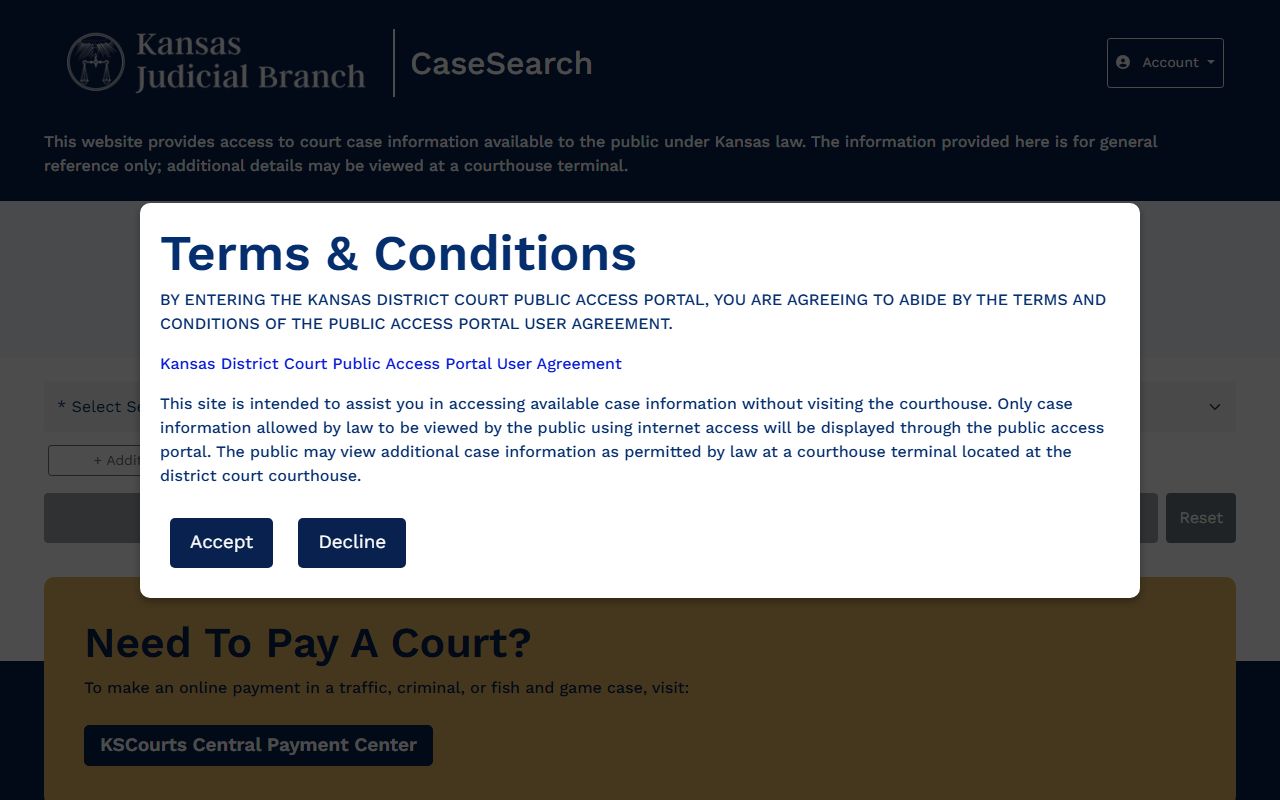
Match results against name, case number, citation, and county before relying on a court record.
Court Search Fields for Grant County Cases
Kansas Case Search accepts several search paths. Defendant name is common after a jail arrest, but a case number or citation number is more precise when available from bond papers, a complaint, a traffic citation, or a court notice.
| Field Label | Type | Required | Format Notes |
|---|---|---|---|
| Case number | Text | No | Best when copied from citation, complaint, bond paperwork, or court notice. |
| Party name | Text | No | Use the defendant's legal name; middle name or initial can help separate similar names. |
| Business name | Text | No | Used when the party is a business rather than an individual defendant. |
| Citation | Text | No | Useful for traffic and citation-based criminal matters. |
| Other criteria | Role-dependent | No | The portal notes that some criteria depend on the user's role and access level. |
Grant County Charging Documents
Booking happens first. Jail staff enter the person into local custody, confirm identifying information, inventory property, check warrant or hold information, and house the person under the sheriff's authority. The formal case begins when a charging document is filed or an existing case is activated by warrant or citation. County Attorney review explains why arrest paperwork may not match the final court charge list.
| Complaint | Information | Indictment | |
|---|---|---|---|
| Filed By | Law enforcement or prosecutor, depending on procedure. | Prosecutor after reviewing the law-enforcement referral. | Grand jury, when that route is used. |
| Common For | Initial misdemeanor or probable-cause paperwork. | Many felony prosecutions after preliminary steps. | Serious felony matters handled through grand-jury process. |
| Why It Matters | May be the first filed accusation after booking. | Shows the prosecutor's formal charge decision. | Shows charges approved through grand-jury action. |
Charge Status and What It Means
Charges can change after a Grant County arrest. A booking entry may reflect the arresting agency's initial custody basis, while the District Court record reflects the prosecutor's filed case and later orders. A charge may be amended, reduced, dismissed, or resolved by plea, trial verdict, diversion, or another disposition. Check each count separately.
| Status | What It Means |
|---|---|
| Pending | The charge has been filed or remains unresolved, with hearings, plea negotiations, or trial settings still ahead. |
| Amended / Reduced | The prosecutor or court changed the charge, level, count, or wording from the earlier filing or booking basis. |
| Dismissed | The court record shows that a count or case was dismissed. Check whether dismissal was with or without prejudice if the record states it. |
| Disposed | The count has reached an outcome such as plea, verdict, diversion result, dismissal, or sentencing order. |
Bond and Release After an Arrest
Grant County does not publish an official bond-payment page, bond schedule, accepted payment methods, or after-hours bond rules. Call the Grant County Jail or Sheriff's Office at 620-356-3500 before traveling. Ask whether bond has been set, whether a no-bond or outside-agency hold exists, which court set bond, what payment methods are accepted, and where payment must be made.
Bond status is not the same thing as filed charge status. The jail can usually confirm current custody and holds. The District Court record is the better source for later bond orders, hearing dates, and filed charges. A warrant can also carry a bond amount or a no-bond direction until the person appears before a judge.
| Bond Type | How It Works |
|---|---|
| Cash Bond | Money is paid directly in the amount and form accepted by the authorized office. Confirm payment rules before arrival. |
| Surety Bond | A licensed bondsman may post bond under Kansas commercial surety practice if the case and jail accept that form. |
| Property Bond | Property may be used where allowed by the court and local procedure. Confirm with the court or jail before relying on it. |
| PR / Own Recognizance | The person is released on a promise to appear and comply with conditions, if the judge allows it. |
| No-Bond Hold | Release is not available on that booking basis until the court or holding agency changes the hold. |
Warrants That Lead to an Arrest
No official Grant County online active-warrant search was located. The sheriff's office serves court papers and District Court processes, and a warrant can lead to booking at the Grant County Jail. For current custody or a warrant booking, call the Sheriff/Jail at 620-356-3500. For filed case records, failure-to-appear issues, and bench-warrant information, call Grant County District Court at 620-356-1526.
Search Kansas Case Search by party name or case number when a warrant may be connected to an existing court file. KASPER should not be treated as a Grant County warrant list; it is for Kansas Department of Corrections custody, supervision, and absconder information. If a person believes there is an active warrant, the safer route is to contact an attorney, the issuing court, or the sheriff before appearing, because self-surrender can result in arrest.
Charges vs. Convictions
An arrest, a filed charge, and a conviction are separate events. A person may be booked at the Grant County Jail, appear in court, and still never be convicted. Public court records after an arrest should be read by stage and disposition, not by charge title alone.
| Charge | Conviction | |
|---|---|---|
| Stage | An accusation filed or carried in a criminal case after arrest or citation. | A final outcome based on plea, verdict, or other judgment of guilt. |
| Proof Level | Earlier stages can rely on probable cause or charging review. | Requires proof beyond a reasonable doubt or a knowing plea. |
| Record Meaning | Shows what was alleged and how the case proceeded. | Shows a criminal judgment unless later set aside, expunged, or otherwise changed by court order. |
Sealed vs. Expunged Arrest and Court Records
Kansas uses expungement procedures for eligible arrest, conviction, and diversion records under K.S.A. 21-6614. Expungement is not automatic, and eligibility depends on the charge, disposition, waiting period, later criminal history, and court findings. Kansas Judicial Branch self-help materials explain the filing process, but the District Court remains the local record source.
| Sealed | Expunged | |
|---|---|---|
| Public Visibility | Hidden or restricted from ordinary public access by rule or order. | Removed from ordinary public view and treated under the Kansas expungement order. |
| Government Access | Some agencies or courts may still have access for authorized purposes. | Authorized agencies may still see or use the record in circumstances allowed by Kansas law. |
| Grant County Route | Ask the District Court clerk about restricted case access when the public search does not display a case. | Use the K.S.A. 21-6614 court process and file in the proper court for the case. |
Background Check Considerations
Kansas Case Search, courthouse records, jail booking information, and KORA requests are public-record access tools. They are not substitutes for a compliant consumer background check. Records can be incomplete, delayed, restricted, expunged, or changed. A dismissed charge is not a conviction, and a booking record does not prove the prosecutor filed the same charge.
Important: Grant County Inmate Population is not a consumer reporting agency and cannot be used for FCRA-covered decisions.
Restricted Grant County Court Records
Kansas open-records law starts from public access, but it also recognizes exceptions. K.S.A. 45-221 is important for criminal-investigation records, correctional records, and other categories that may be closed or redacted. Court rules can also restrict juvenile matters, sealed filings, expunged cases, protected personal information, victim information, and records that are not public by law.
The Kansas District Court Records page explains statewide access and restrictions.
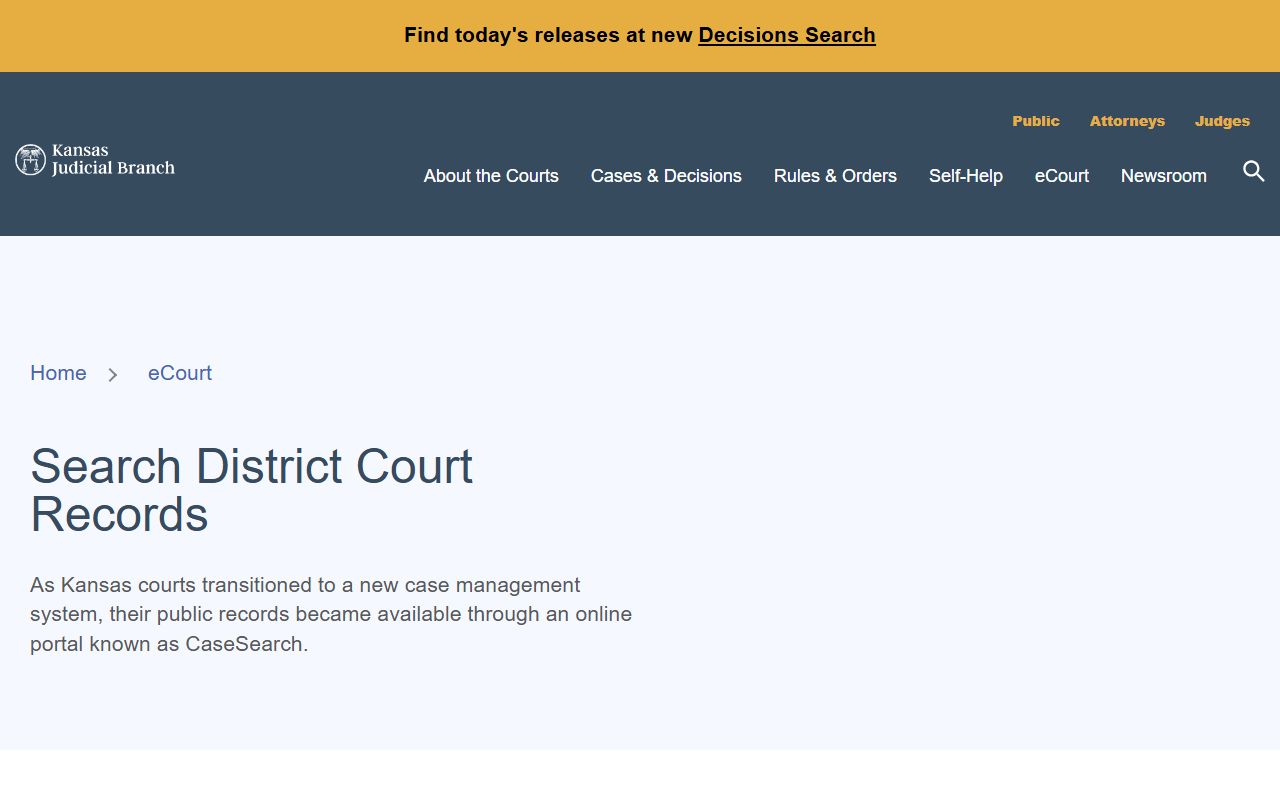
When a Grant County search result is missing or incomplete, the correct next step is to verify with the District Court clerk rather than assume the arrest never reached court.
Grant County Arrest Offices
The jail, prosecutor, and court have different jobs after an arrest. The Grant County Jail and Sheriff's Office at 210 E. Central Avenue handle local custody at 620-356-3500. The Grant County Attorney at P.O. Box 967, 108 S. Main, Ulysses, KS 67880, phone 620-356-3155, prosecutes referred crimes, aids investigations, and drafts subpoenas or search warrants. Hours are Monday through Thursday, 8:30 a.m. to 4:30 p.m., and Friday, 8:30 a.m. to noon.
Public Record Search
Sponsored Results